
One platform. Designed to work across the full care journey.
Every component is designed by practicing medical professionals. Every decision controlled by providers.
Designed by medical experts for disclosure and information collection.
15–45 minutes, no provider time consumed
Adapts in real time
For intake, a thorough and complete history is collected. For follow-ups, newly expressed symptoms and concerns trigger structured depth collection with detailed follow-through. Stable symptoms previously mentioned receive report confirmation.
Configured by your clinic
Your team selects the relevant clinical domains for your patient population and clinic needs. Chronic pain, behavioral health, neurology, maternity, oncology supportive care: the assessment architecture changes. The underlying conversational skills and safety system do not.
Continuous safety monitoring
Every session may include structured safety screening from the first question to the last. Risk indicators are flagged at the moment of disclosure and routed to the supervising clinician. Safety questions override session time limits.
Cross-session continuity
Follow-up sessions build on the prior visit, not on a blank slate. The system tracks what changed, what is stable, and what your team flagged for closer attention.

Each session has a job.
AugMend sessions fall into two families: data-collection sessions that capture patient reported data, and exercise sessions that put care into practice.
Intake Sessions
Cover configured clinical domains in breadth and depth.
Follow-up Sessions
Changes-focused. Medication updates, symptom shifts, new concerns.
Exit Interview
Captures the patient's experience of the care episode before they leave.
The non-human avatar conducts the conversation. Patients speak; the system listens, adapts, and structures.
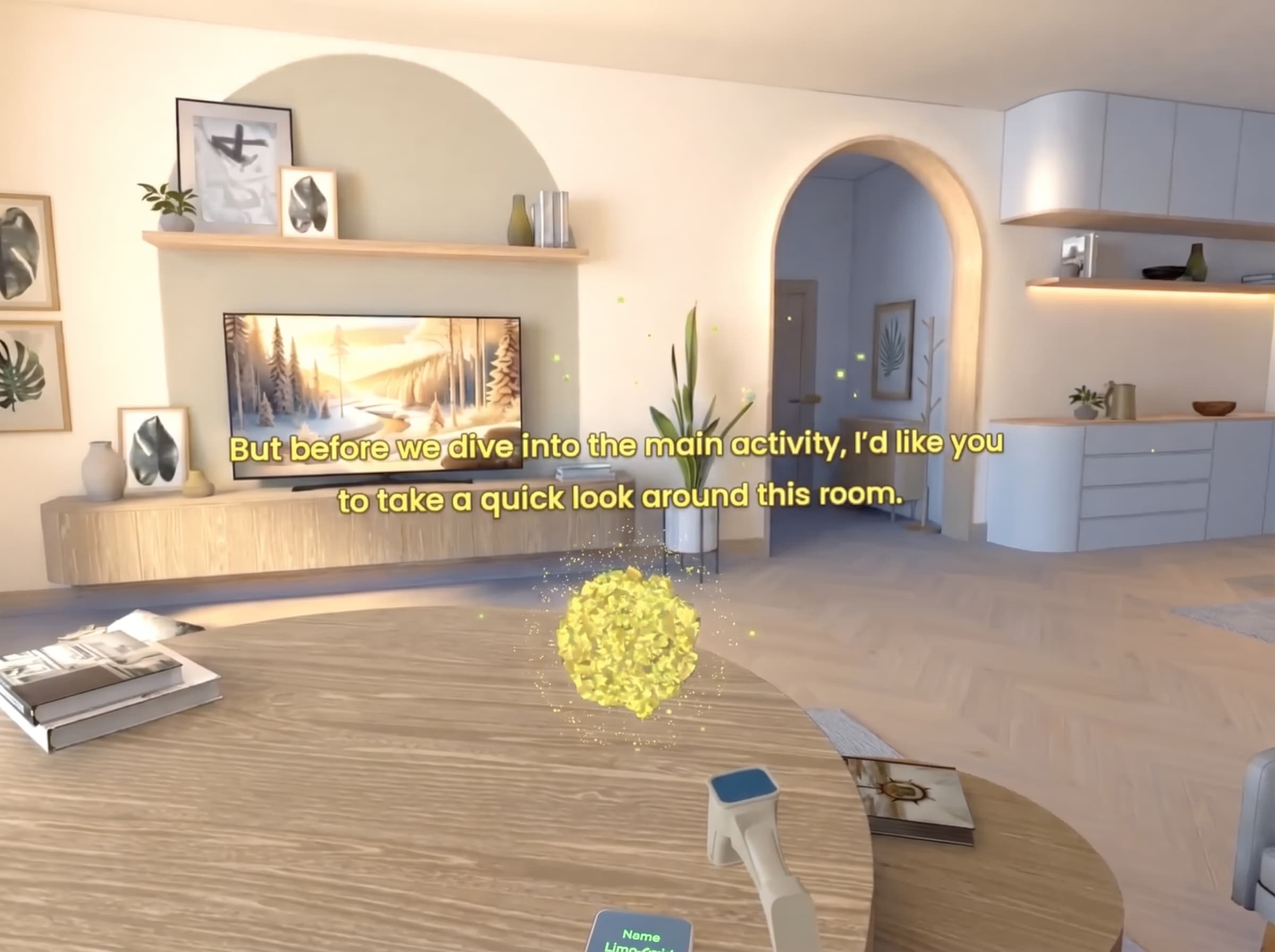
Provider prescribes; patient practice.
Relaxation
5–10 minGuided breathing, somatic, and grounding exercises delivered in immersive VR.
Psychoeducation
5–10 minPatients learn evidence-based concepts about their condition. Comprehension is checked.
Behavioral activation
15–20 minShort structured exercises that rehearse coping skills and target specific patient goals.
Pain management
15–20 minDistraction-based and reappraisal-based VR experiences that reduce acute pain perception.
The provider makes every clinical prescription decision. Non-medical staff manage the headset; the clinician owns the plan.
The right report format for the right information.
Every session generates structured outputs from the same data: a clinical report for review, billing-ready documentation, and the source transcript behind every claim. For example, scroll to see what your team reads on day one.
Patient self-report on a narrative VAS, captured across both intake sessions without a clinician present.
Functional safety: right-knee instability on stair descent under load. Patient acknowledged. Programmatic, not diagnostic.
No depression signal. PCS 0%. GAD-7 below threshold. Suicidality denied. Substance-use screening clean.
Every clinical assertion is dotted-underlined and traces to the patient's own words in the source transcript.
Five-bullet rapid review at the top, eleven domains expanding inline below, provider reads what they need, when they need it.
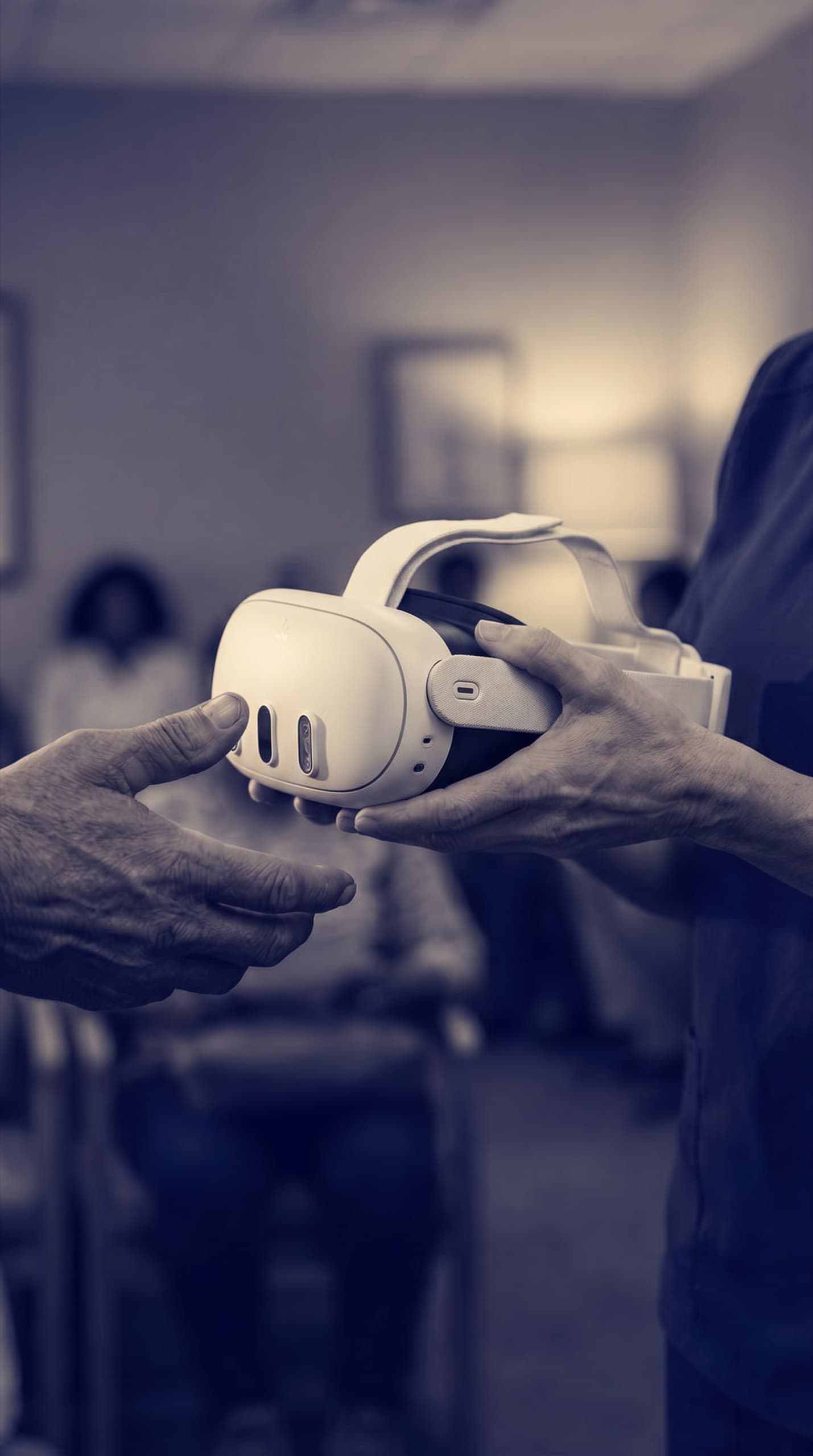
Immersion changes what patients share.
Standard clinical intake happens in environments shaped by time pressure, social judgment, and institutional formality. VR removes those barriers. In a controlled immersive environment, patients engage longer, disclose more, and report greater comfort sharing sensitive information.
Data from our randomized controlled trial shows VR consistently outperforming web-based AI across engagement, disclosure comfort, and overall experience. VR responses were 30% longer. Patients elaborate more when the environment supports it.
| Domain | VR | Web AI | Diff |
|---|---|---|---|
| Privacy & Trust | 6.0 | 4.9 | +22% |
| Medical Disclosure Comfort | 6.67 | 5.0 | +33% |
| Future Use & Preference | 6.38 | 5.0 | +28% |
| Core Experience | 6.42 | 4.92 | +30% |
| Cultural Competence | 6.5 | 6.25 | +4% |
| Overall Experience | 6.29 | 5.86 | +7% |
Data from our randomized controlled trial, n=45
“VR showed higher median ratings than desktop across several domains, with moderate-to-large effect sizes in Core and Overall Experience.”
AugMend RCT, MIT.nano Immersion Lab (n=45, NCT07538387) — under peer review
Why a non-human avatar.
Research in human-computer interaction shows that people disclose more to agents they perceive as non-human. The absence of a human face removes the fear of judgment, social desirability bias, and the self-editing that shapes every clinical encounter.
AugMend’s conversational avatar is deliberately non-human. It creates psychological distance from the clinical relationship while keeping the warmth and responsiveness of a guided conversation. Patients don’t perform for it. They speak to it.
The environment and avatar are chosen deliberately by the clinical team, for each patient — to increase comfort, engagement, and disclosure.
“People disclose more when they believe they’re interacting with a non-human agent, experiencing less fear of judgment and greater willingness to share sensitive information.”
Lucas et al. (2014), Computers in Human Behavior · USC ICT
Safety design and integration live where they belong: in your clinic.
Safety design
Continuous safety screening, evidence-linked claims, and clinician-controlled sign-off. See how it operates inside your workflow without adding to provider burden.
See it in practiceDeployment & integration
Want to see how to get it set up and integrated into your workflow? Most clinics go live in under four weeks. See the full deployment story on the In Practice page.
Integrate it into your workflow