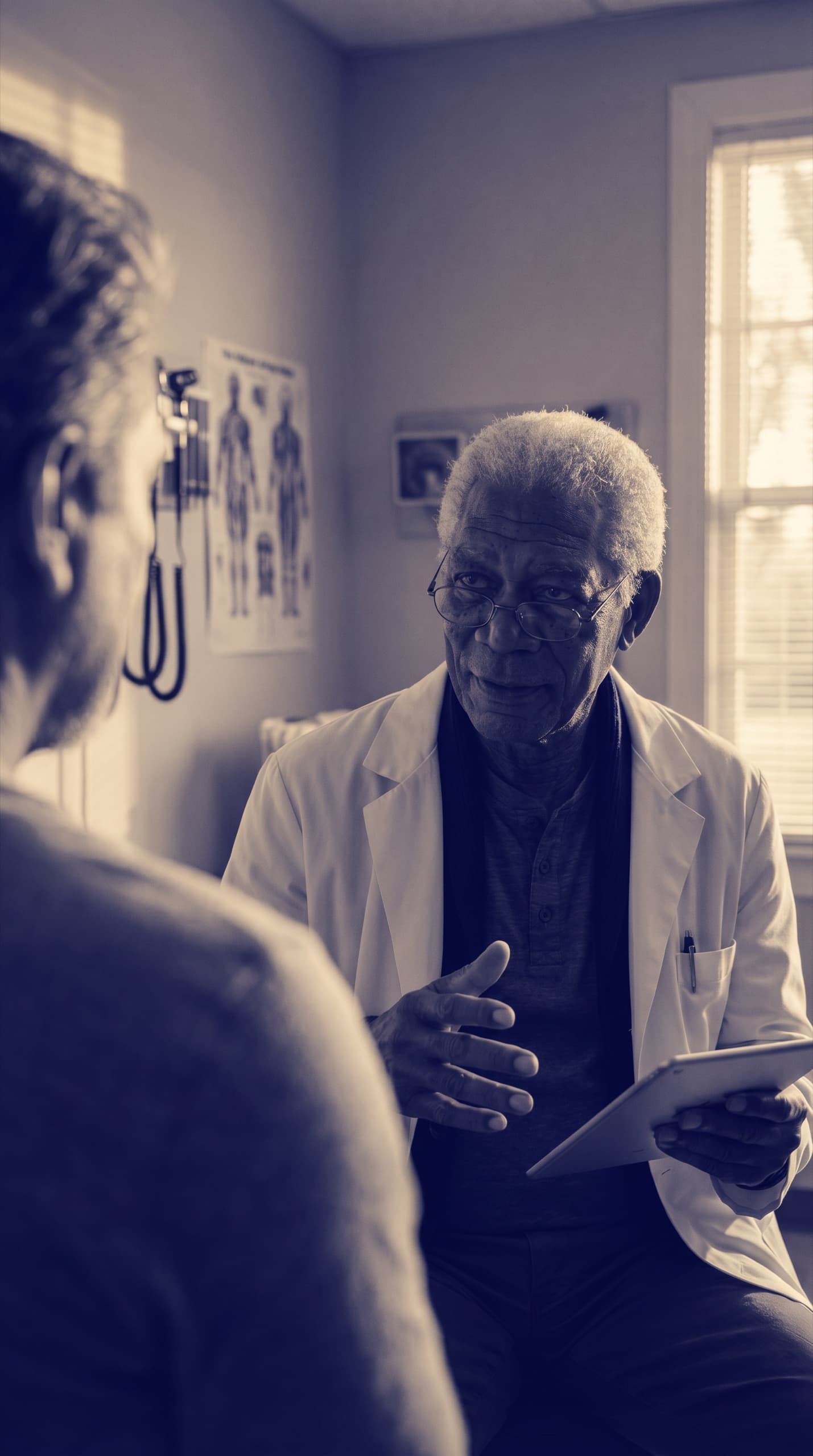
An integrated software solution for patients, providers, and practice leaders.
AugMend fits inside the workflows clinics already have. No new staff. No new billing systems. A structured session before the face-to-face patient-provider encounter. A report is waiting when the provider first walks in. A report can be addended by the provider after the visit and is ready to submit for billing.
One pilot. Seven stages. From the patient’s pre-visit consent to the clinician’s sign-off.
The journey runs from the patient through the system into the provider. Each stage names its owner, its purpose, and how long it takes.
- 01PatientBefore visit
Pre-session survey, digital consent, OTP issuance.
The clinician authors the session plan of the appointment. Patient receives the consent flow and a one-time access code in advance.
- 02PatientArrival & setup
Patient checks in at clinic. Admin hands off the headset and runs a pre-check.
Non-clinical staff complete a 90-second pre-flight: hardware fit, audio levels, and session ID. The patient is in immersion before the room is even ready.
- 03PatientVR intake session
Patient converses with the avatar across 11 clinical domains; VR exercise if prescribed.
The non-human avatar conducts a structured biopsychosocial conversation. Adaptive depth-collection on new disclosures. Continuous safety screening behind the scenes.
- 04SystemPost-VR & report generation
Transcript processed; clinical report, 15-second pre-visit summary, and flags generated.
Every claim is linked back to the originating exchange in the transcript.
- 05ProviderProvider pre-visit review
Clinician reads the 15-second summary
Two-minute structured brief surfaced to the provider's existing EHR view. Walk into the room with the full clinical picture already in mind.
- 06ProviderIn-room visit
Clinician anchors the visit on the report, clarifies with the patient, annotates inline.
The conversation is no longer information-gathering — it is shared decision-making. Annotations attach directly to the report.
- 07ProviderPost-visit sign-off
Clinician finalizes, signs off; report locks and EHR copy-paste path activates.
Billing-ready documentation is pre-populated and mapped to existing CPT codes. Provider review takes minutes, not the rest of the day.
When patients use AugMend, they share more, more honestly.
The same conversation a patient finds hard to have face-to-face becomes possible in immersion. The numbers below come from our randomized controlled trial.
Patient preference for VR-based assessment.
Across the Boston RCT, every participant preferred VR-based sessions over standard intakes when offered both.
More words disclosed per response.
Patients say more, more honestly surfacing clinical information that standard intakes consistently misses.
Provider sees the full picture.
The first session gives the care team context that previously took months of clinical relationship to build.

Restructure what happens before you walk in the room.
The provider workflow stays the same minus the parts that drained it. Diagnosis and shared decision-making, with the documentation already in hand.
More face time, less keyboard time
15+ minutes back per encounter. The brief replaces the unstructured interview. The face-to-face visit becomes diagnosis and shared decision-making.
Decision confidence
Every claim trace to the source transcript. Flagged items are explicit. Providers know what is solid and what to verify with the patient.
Cognitive load offloaded
12+ clinical domains pre-organized: meds, history, function, SDOH, safety, prior treatment. The provider walks in with the picture, not a blank page.
Burnout pressure relieved
Documentation drops from hours to minutes per encounter. The afternoon ends with the patients, not with the EHR.

Revenue from day one, with the billing infrastructure you already have.
No new staff. No new billing systems. AugMend slots into the existing workflow and starts producing structured documentation — and structured revenue — from the first session.
$83+ per session, day one
Generated under existing CPT codes. No new billing infrastructure. Revenue realized from the first completed session.
Higher-level E/M support
Structured biopsychosocial complexity is the basis for higher-level coding. The complexity is now documented, evidenced, and provider signed.
Four steps to live
Contract → hardware → trained staff → first patient session. Pace varies by clinic; most reach steady-state shortly after their first sessions.
Quality metrics improve alongside revenue
Structured SDOH, PROMs, and intake data. The type of data high quality care already requires, generated as a byproduct of our solution.
The AI guides. The provider decides. Every time.
AugMend does not interpret clinical data, render diagnoses, or generate treatment recommendations. Every session runs under the remote supervision of a licensed clinician. Every output requires provider review before it enters the clinical record.
Continuous safety screening
Every session may include structured safety screening from the first question to the last, tailored to provider preferences. Risk indicators route to the supervising clinician at the time of disclosure.
Evidence-linked claims
Every finding trace to the source transcript and audio. Providers can open the originating exchange for any claim. Uncertain items are explicitly flagged for review.
Clinician-controlled, effortlessly
The clinical team owns the plan. Sessions launch under remote supervision of a licensed clinician. Sign-off is required before anything enters the record. Configurable in minutes, not added to provider workflow.
We integrate with your existing tools.
AugMend can integrate with major EHRs over FHIR-compliant APIs as well as scribes or other existing tools. Patient data stays inside your existing infrastructure. HIPAA-compliant from day one and SOC 2 Type II available. The deployment runs in four steps; pace varies clinic to clinic.
EHR connectivity
Compliance & security
Hardware is managed by non-clinical staff. AugMend provides the setup guide, the training, and the technical support. The clinical team configures sessions and signs reports — nothing else.
From contract to first
patient session.
- Step 1Contract signed. Hardware purchased.
- Step 2Staff trained. System configured. EHR connected.
- Step 3First patient sessions. First reports. First revenue.
- Step 4Full workflow running. All session types active.
Start a structured pilot.
We work with specialty care practices. The deployment runs in four steps — pace varies clinic to clinic.
Schedule a Conversation →